
Green walls in Compton? Start here
painted render and brick walls, slate and clay tile roofs, 1.6 miles from the yard.
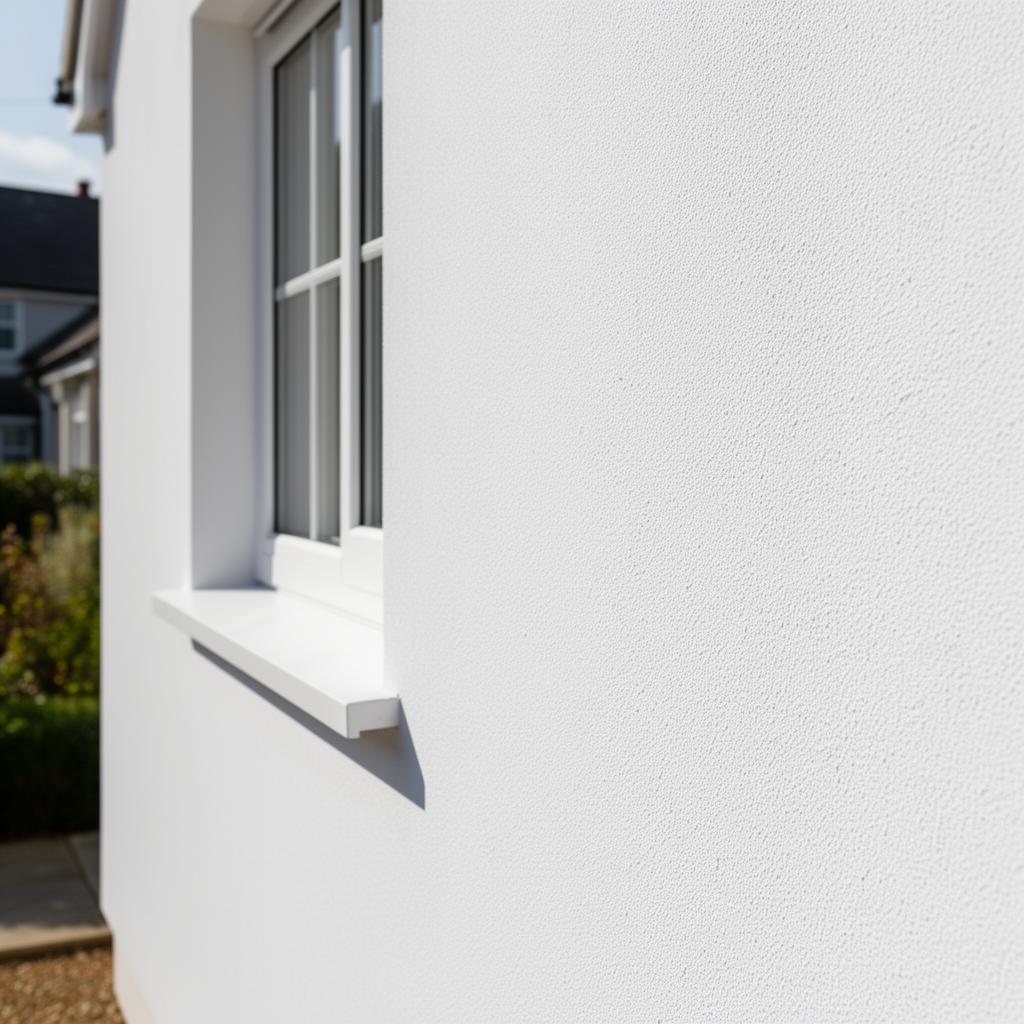
Where a Compton wall has gone patchy rather than evenly dirty, the cause is nearly always local: a downpipe, a hedge, a shaded corner. That is where we look first.
Compton rises north from Mutley Plain and is recorded as a leafy inner suburb with painted render and brick beneath slate or clay tile. The mixed finish makes boundary details central to diagnosis. Survey notes distinguish render panels, brick bands, bay edges, sill run-off and shaded garden returns, then identify where vegetation restricts airflow or access without assuming it caused the staining. A render test patch and brick test patch are considered separately. Protection planning also covers nearby planting and openings, so application and rinsing can be controlled around the actual elevation rather than based on a generic suburban house layout.
The Devon detail
- Typical roof covering here is slate and clay tile, which affects what washes down onto the walls.
- PL3 covers 7 town hubs and 1 villages or districts in our radius.
- Recorded character: city district. Leafy inner suburb rising north from Mutley Plain.
- Mannamead sits about 0.2 miles from Compton on our round, so visits are often shared.
- Access is usually via Mutley Plain and A386.
painted render and brick and what it needs
- Render cleans up well at low pressure and badly at high pressure, because pressure removes the finish along with the growth.
- Render responds to dwell time better than almost any other finish, which is what makes softwash suit it.
- Brick tolerates more than render does, but the mortar between it does not.
- Painted brick is treated as paint, not as brick, and the test patch decides the strength.
- That gets pointed out before work starts rather than discovered halfway through.
- Painted plinths take splash and are worked as a separate band from the main face.
Application, dwell and rinse
- 1.Photographs are taken of anything found in poor condition, so it can be shown rather than described.
- 2.The lance is held at a distance and an angle that lets the fan open fully instead of hitting the wall as a jet.
- 3.Where a wall runs straight down to a lawn, a run of sheeting is pegged along the base instead of relying on dilution alone.
- 4.Areas that stay stubborn after full dwell are left to weather rather than pushed harder on the day.
- 5.The strength of mix is stepped up only after a weaker one has been given its full dwell and judged.
- 6.Fence panels tight against a wall are wetted first so run-off does not sit on dry timber.
- 7.The mix is made up in small batches as the work moves, rather than one large batch that stands and weakens.
- 8.Where a wall abuts a neighbour's boundary within a metre, the fan is narrowed and the pass slowed.
- 9.Rainwater goods are checked while the elevation is being worked, since a blocked hopper explains most single-strip staining.
- 10.Where growth has spread onto a UPVC panel or door surround, it is wiped rather than sprayed.
The survey we do in Compton
- 01A damp meter reading inside a stained corner separates a cleaning job from a building problem.
- 02Where paint is peeling in flakes rather than powdering, adhesion has already gone.
- 03Anything that cannot be explained by water is treated with more caution, not less.
- 04A fingernail drawn across the growth says more in a second than a photograph does.
- 05How quickly a splash of water darkens the surface says how porous the finish has become.
- 06Where the pattern is even across the whole face, exposure and aspect are the cause.
- 07The age of the finish is estimated before a strength of mix is chosen.
- 08Any staining that continues below ground level is a drainage question, not a cleaning one.
Planning a full exterior in Compton
Glass is done last on any multi-service visit, since it picks up whatever the earlier stages put in the air.
Where scaffolding is going up for other work, the wall clean is easier and safer while it is standing.
Where gutters need repair rather than clearing, that goes ahead of any cleaning at all.
Driveways come after walls so that run-off from the elevation is rinsed away as part of the drive work.
What to tell us in advance
- Tell us if a fence panel is loose, because sheeting gets pegged to something solid.
- Say if the property has a flat roof section that we would be working above.
- Say if you would prefer the front done on a different day from the back.
- Say whether the side passage is wide enough for a wheeled kit trolley.
- Note the position of the stopcock in case the outside tap needs isolating.
- Point out ground-floor windows that are painted shut, as they need different masking.
- Say if the elevation is overlooked by a neighbouring window that should stay shut.
- Let us know if scaffold or a tower is already up for other work.
Practical questions answered
- Do you offer a maintenance visit?
- A lighter top-up treatment every couple of years is much less work than leaving it until it is heavy again.
- Do you clean under the eaves?
- The soffit line is in the spray path and gets a pass as part of the work.
- Can two elevations be done on separate days?
- Yes, and splitting a larger property over two visits is normal.
- Do you take the waste away?
- There is very little on a wall job. What comes off the surface is rinsed to a drain that can take it.
- What about the smell for neighbours?
- Mild and short-lived, and we avoid boundary elevations when someone next door has washing out.
- Is the method different on a listed building?
- The approach is gentler still, and lime finishes are treated with the lowest strength that will work.
- What if the render is hollow in places?
- It is tapped and mapped first, and hollow sections are treated dry-side only rather than soaked.
- Is it safe around pets?
- Keep them indoors during application and for a couple of hours after, and there is nothing to worry about.
Neighbouring places we work
Summary
Written price first, method matched to the surface, then the work. In that order. If a previous clean did not last, the cause was probably never dealt with. Method, dwell and patience beat pressure and speed on every wall finish we work on.
Not a hard sell
If the job is not worth doing yet, we will tell you that and you can call us next year.
Quote for a Compton property
Monday to Saturday, 8am – 7pm