
Green walls in East Allington? Start here
cob and lime render walls, slate roofs, 15.9 miles from the yard.
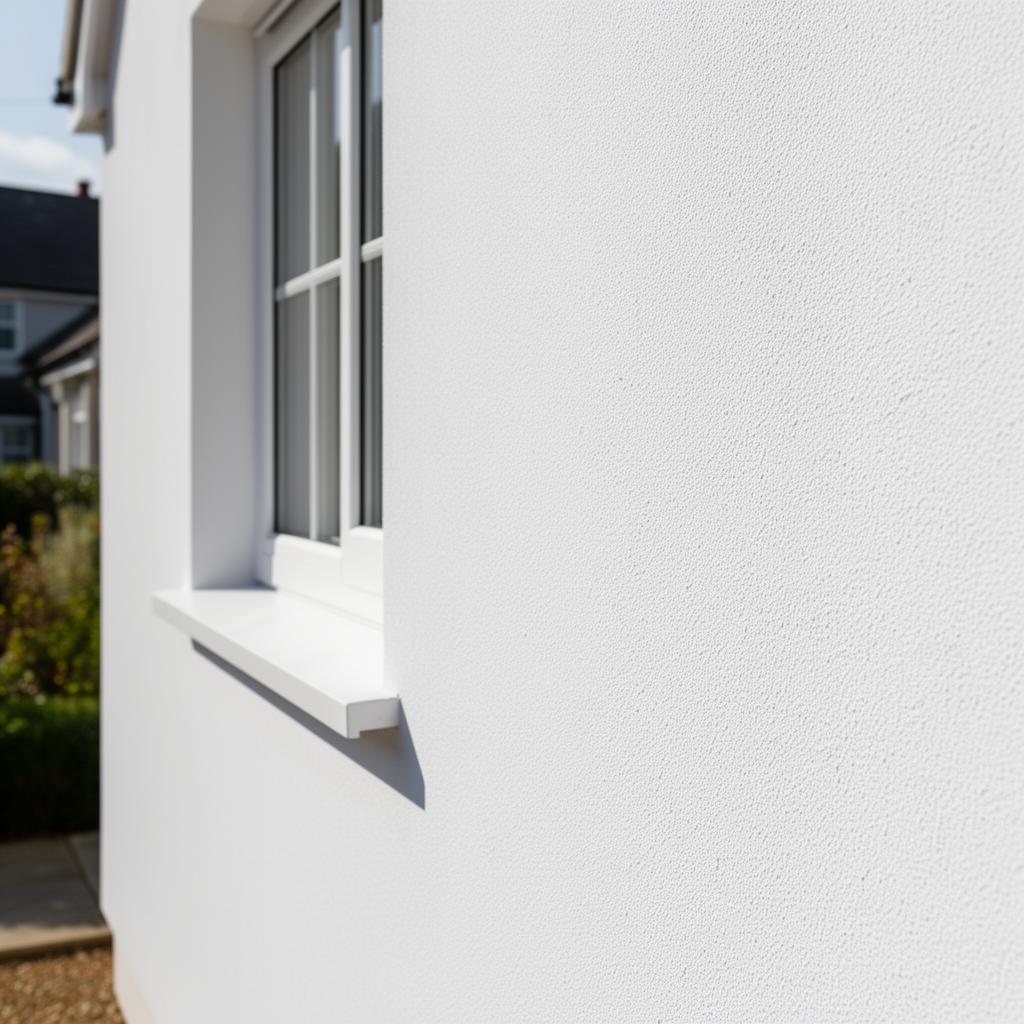
We work East Allington as part of the Modbury round, which keeps travel down. Wall softwash is the service most often asked about here because cob and lime render shows growth earlier than brick does.
Quote for a East Allington property
Monday to Saturday, 8am – 7pm
Why walls green up in East Allington
- Overhanging eaves protect the top of a wall and leave the unprotected lower band to take everything.
- Shading from a neighbouring building can matter more than the aspect of the wall itself.
- Guttering that has dropped at one end holds standing water and drips continuously at the low point.
- A textured coating applied over an already dirty surface holds that dirt as a feeding layer.
- A downpipe discharging onto a hard surface next to the wall sends the water straight back at the brickwork.
- Where two elevations meet in a tight internal corner, neither one dries properly.
- Painted walls chalk with age, and chalked paint is a rougher surface than new paint.
- A wall under a mature hedge takes both shade and constant leaf litter, which is the worst pairing there is.
- A split downpipe puts a single wet stripe down an elevation, and that stripe goes green months before anything either side of it.
What the staining pattern tells us
- 01The presence of moss rather than algae suggests standing water rather than damp air.
- 02The elevation is read from the pavement first and from a metre away second.
- 03Efflorescence is distinguished from lichen before anything is applied, since one is salt and one is alive.
- 04The state of the pointing is judged at the most exposed corner, not the most convenient one.
- 05Any staining that continues below ground level is a drainage question, not a cleaning one.
- 06The underside of the soffit is checked, because staining there rarely stays there.
- 07A wall that is warmer than its neighbours on a cold morning is likely holding moisture.
- 08The first question is whether the staining sits on the surface or has gone into the material, because only one of those cleans off.
Getting a East Allington property ready
- Say if you would prefer the front done on a different day from the back.
- Say if there is a wasp or bird nest under the eaves, and we will plan around it.
- Unlock side gates the night before if you are not going to be in, because a locked passage stops a whole elevation.
- Say whether the property is occupied during the day, since that changes nothing technically but helps the plan.
- Let us know if anyone in the house works nights and needs quiet at a particular time.
- Move cars off a drive that runs tight to the house if you can, and tell us if you cannot.
- Let us know if a neighbour parks under the wall on certain days.
- Say whether the elevation backs onto a public footpath.
What the surface will and will not take
- Cracks in render change the staining pattern, because water then sits behind the face as well as on it.
- Patched render takes treatment differently from the original, which is why patches are identified before work starts.
- Cob and lime-finished walls are moisture-sensitive by design.
- Thatch or deep eaves above cob change how much of the wall ever gets wet.
- High pressure and hard sealants both work against how a lime wall is meant to behave.
- The colour of a lime finish is in the material, so it returns rather than being restored.
The method we would use in East Allington
- 1.The treatment is mixed to the surface, not to a fixed recipe, and a delicate finish gets a weaker mix and a longer wait.
- 2.Application is by low-pressure fan, closer to a garden sprayer than a washer, and the wall is wetted evenly rather than saturated in patches.
- 3.The mix is made up in small batches as the work moves, rather than one large batch that stands and weakens.
- 4.Hoses run outside gates where children or dogs are about, and gates are closed behind us each time.
- 5.Sheeting comes off from the top down so nothing collected on it lands on cleaned work.
- 6.Any window left open is closed, or that section is skipped and left for a second visit.
- 7.Dwell time is the active ingredient. The treatment is left on the growth long enough to kill it rather than being chased off with water.
- 8.Where a lean-to gutter runs at wall height, it is cleared first so it does not overflow mid-visit.
- 9.Where growth has spread onto a UPVC panel or door surround, it is wiped rather than sprayed.
- 10.Any garden furniture within the spray arc moves before the mix is made up, not while the lance is running.
Practical questions answered
- Do you cover air bricks the whole time?
- Covered while the wall around them is worked and uncovered before we go.
- Can you remove ivy marks?
- Suckers can be treated and weathered off, though the shadow of an old ivy run can take a season to fade fully.
- Do you clean UPVC panels and door surrounds?
- They are wiped by hand rather than sprayed.
- Is it worth cleaning a wall in winter?
- Yes. Cool damp conditions suit the method, and heavy rain during application is the only real obstacle.
- Should I fix the downpipe before or after?
- Before, if it is the cause. Cleaning around a live leak puts the stain straight back.
- Can you treat a wall that has already been jet washed?
- Yes. The damaged band is worked at a reduced strength because it is more open than the rest.
- Can you get behind downpipes?
- Yes, by hand. It is the part a sprayed pattern always misses.
- Do you clean chimney stacks?
- Where they can be reached safely from a position that keeps us off the roof covering.
Planning a full exterior in East Allington
Driveways come after walls so that run-off from the elevation is rinsed away as part of the drive work.
If a decorator is due, the wall clean goes in first and is given time to dry fully.
Solar panels are cleaned separately from the roof slope they sit on, and after it.
Booking services out of order is the commonest reason a clean seems not to have lasted.
Neighbouring places we work
TQ9 context
- Typical wall finish here is cob and lime render, which sets the cleaning method.
- Access is usually via A379.
- Recorded character: village. Church and inn village between Totnes and Kingsbridge.
- Postcode district: TQ9. County: Devon. Approx 15.9 miles from the PL3 base.
- Nearest full coverage hub: Modbury (PL21), South Hams District Council.
Summary
Method, dwell, rinse, check. There is nothing else to it. Written price first, method matched to the surface, then the work. In that order. A maintenance pass is far lighter work than a first clean, and it stays that way.
Selling the house?
Clean elevations change the first photograph, and the first photograph is what gets viewings.