
Wall and render softwash near Hannafore
painted render and stone walls, slate roofs, 15.7 miles from the yard.
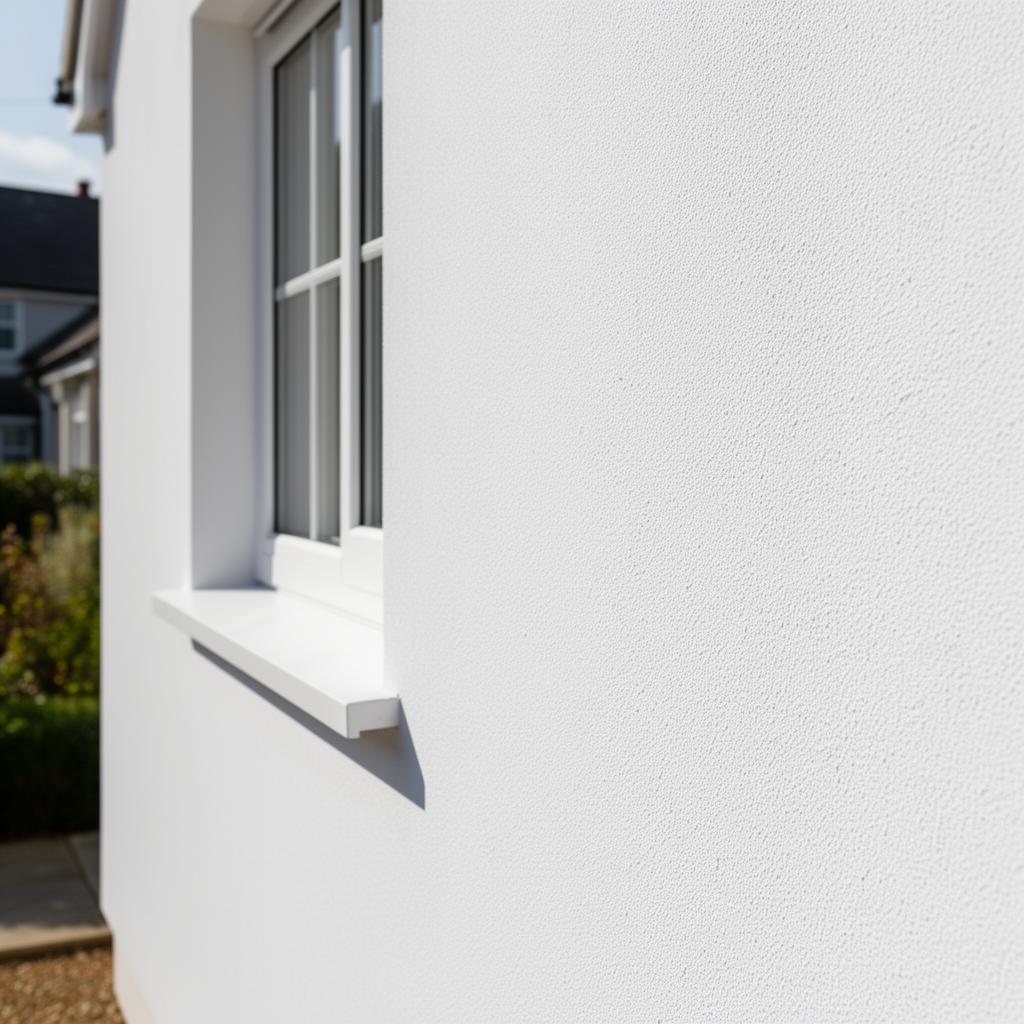
Hannafore is a coastal hamlet within the PL13 area, roughly 15.7 miles out from PL3 and one of 17 places we cover in that district. Its painted render and stone walls behave in a predictable way once you know the exposure.
Quote for a Hannafore property
Monday to Saturday, 8am – 7pm
Why walls green up in Hannafore
- Once lichen is established it holds water itself, which makes the surface beneath it wetter than it started.
- Overflowing gutters feed the top of the wall continuously through the wet months.
- Bird activity along a gutter line concentrates nutrients on the wall directly below it.
- Cracked render lets water sit behind the face as well as on it, so the staining pattern follows the crack.
- Old sealant around window heads cracks and lets a thin trickle run down the face below.
- The first sign is usually a faint grey cast rather than green, and grey is easier to ignore.
- A blocked hopper head can soak the same square metre of wall for an entire winter without anyone noticing.
- Overhanging eaves protect the top of a wall and leave the unprotected lower band to take everything.
- Frost damage opens the surface slightly, which gives the next season's growth somewhere to sit.
What the staining pattern tells us
- 01Whether the render is thin-coat or traditional is checked at a bead or a reveal.
- 02The ground level relative to the damp course is checked before the base of a wall is treated.
- 03Where the pattern is a band at the top, the gutter line is doing it.
- 04Anything that cannot be explained by water is treated with more caution, not less.
- 05A damp meter reading inside a stained corner separates a cleaning job from a building problem.
- 06Any staining that continues below ground level is a drainage question, not a cleaning one.
- 07The direction the growth thickens in points at the source of the moisture.
- 08The angle of morning sun on the elevation tells you how long it stays damp.
Getting a Hannafore property ready
- Let us know if anyone in the house works nights and needs quiet at a particular time.
- Say where the outside tap is, and whether it runs at any pressure.
- Mention any planned decorating so the drying window can be built into the date.
- Tell us about any planting you particularly care about at the base of the wall.
- Clear the base of the elevation of pots, ornaments and loose paving where you can.
- Point out any window that does not seal properly, so it gets sheeted rather than sprayed near.
- If there are children's toys or a trampoline against the wall, they need to move.
- Trim back anything that has grown tight against the wall, or ask us to work around it.
What the surface will and will not take
- Render cleans up well at low pressure and badly at high pressure, because pressure removes the finish along with the growth.
- A rendered wall under a failed drip detail restains within a season however well it was cleaned.
- That gets pointed out before work starts rather than discovered halfway through.
- A test patch low down and out of sight is how failing paint is found deliberately.
- A stone wall in deep shade holds moss in the joints long after the faces have dried.
- Loose stones and open joints are recorded and left alone rather than washed.
The method we would use in Hannafore
- 1.The wall is left to dry naturally rather than being wiped, which is what keeps the finish even.
- 2.Anything that has to be moved - bins, planters, a bike - goes back exactly where it was found.
- 3.Corners are worked from both directions so the overlap sits in the angle and not on the open face.
- 4.Application is by low-pressure fan, closer to a garden sprayer than a washer, and the wall is wetted evenly rather than saturated in patches.
- 5.Guttering above a worked elevation is checked for standing water, because a drip mid-treatment ruins an even finish.
- 6.Dwell time is the active ingredient. The treatment is left on the growth long enough to kill it rather than being chased off with water.
- 7.Work stops if a wall turns out to be wetter inside than out, because cleaning is not the answer to that.
- 8.Chimney stacks are treated from a position that keeps the operator off the roof covering entirely.
- 9.Waste water is directed to a soakaway or drain that can take it rather than allowed to pond on a lawn.
- 10.The same operator works a whole elevation so the application rate stays consistent across it.
Asked most often in PL13
- Will the wall need doing again next year?
- Not usually. How long it holds depends on shade, run-off and airflow rather than on the treatment.
- Do you clean render above a flat roof?
- Yes, with the roof covering sheeted and the drip detail checked.
- Do you treat garden and boundary walls on their own?
- Yes, where the method matches and access allows.
- Is the finish even across the wall?
- That is the main reason we work bottom-up and one elevation at a time.
- Can you clean a wall before painting?
- Yes, and it should be done first. Paint over live growth fails from underneath.
- How much water does a wall job use?
- Less than a pressure wash, because the work is dwell time rather than volume.
- Do you offer a maintenance visit?
- A lighter top-up treatment every couple of years is much less work than leaving it until it is heavy again.
- How do you price the work?
- By elevation area and access, put in writing before anything starts.
Sequencing the outside of the house
Driveways come after walls so that run-off from the elevation is rinsed away as part of the drive work.
Where a roof clean is planned for later in the year, walls are worth leaving until after it.
If windows were cleaned recently, tell us, and they get sheeted rather than redone.
Where scaffolding is going up for other work, the wall clean is easier and safer while it is standing.
Close to Hannafore
PL13 context
- Recorded character: coastal hamlet. Sea-front headland at West Looe.
- Typical wall finish here is painted render and stone, which sets the cleaning method.
- Postcode district: PL13. County: Cornwall. Approx 15.7 miles from the PL3 base.
- Typical roof covering here is slate, which affects what washes down onto the walls.
- PL13 covers 3 town hubs and 14 villages or districts in our radius.
Useful pages alongside this one
Hannafore wall softwash, in short
Shade is not a fault in a house, but it is the reason one elevation always looks worse. Read the staining pattern first and the answer usually names itself. Ask what will be used and how long it will be left on. The answers tell you everything. Monday to Saturday, 8am to 7pm.
Talk it through on the phone
Five minutes on the phone usually settles what a form cannot.