
Softwashing painted stone and render walls around Talland
painted stone and render walls, slate roofs, 17.1 miles from the yard.
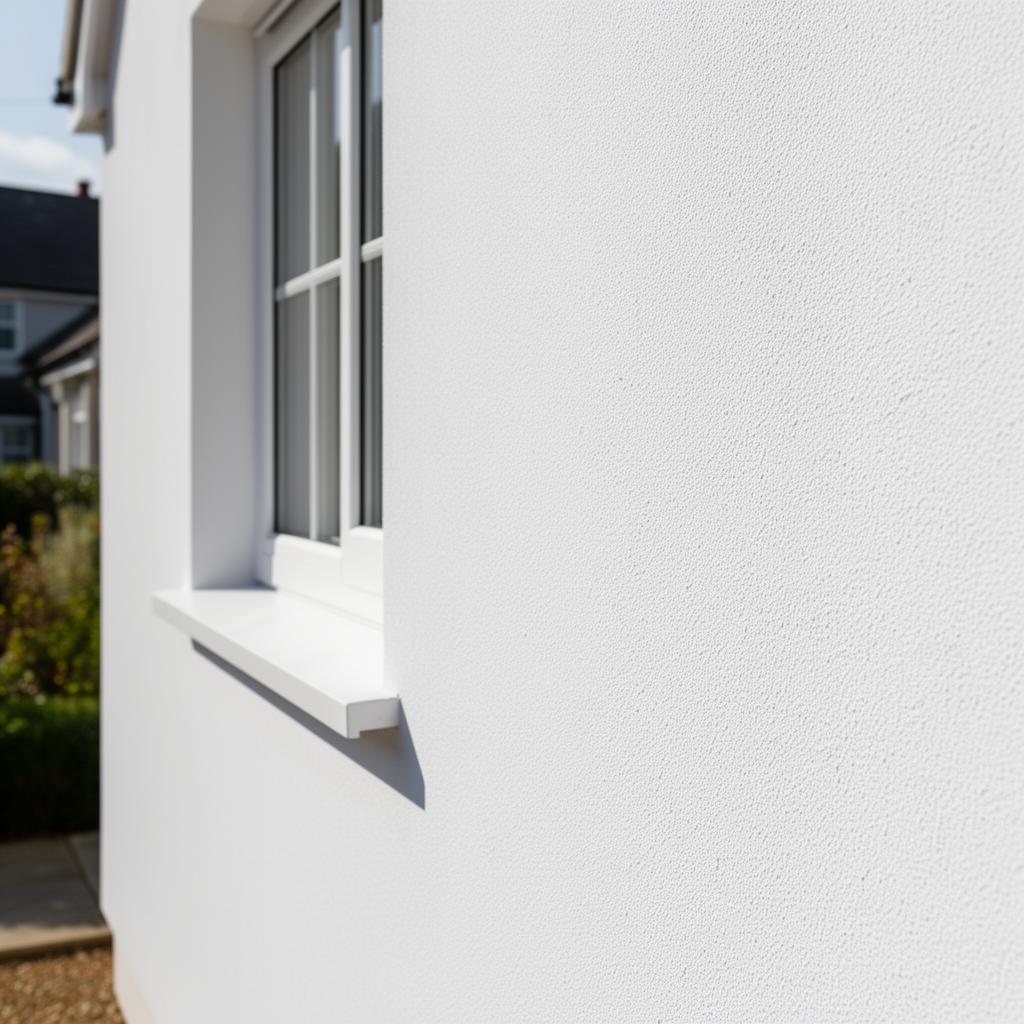
A wall in Talland that has greened over is telling you where water sits. Twin-tower cliffside church between Looe and Polperro, so the pattern of staining tends to repeat from one property to the next.
Quote for a Talland property
Monday to Saturday, 8am – 7pm
Why walls green up in Talland
- A wall shielded by a car port dries slowly because it never sees direct sun or driven rain.
- The first sign is usually a faint grey cast rather than green, and grey is easier to ignore.
- Prevailing wind decides which elevation takes driven rain, and that elevation is nearly always the tired-looking one.
- A blocked hopper head can soak the same square metre of wall for an entire winter without anyone noticing.
- The lowest metre of any wall takes splash-back off the path and stains from the ground up, not the top down.
- Where a chimney is no longer used, rain that once dried out now sits in the stack and shows on the wall below.
- Mild damp winters here keep growth metabolising through months that would stop it in a colder, drier county.
- Overhanging eaves protect the top of a wall and leave the unprotected lower band to take everything.
- Where a gutter joint weeps rather than pours, the stain is thin, vertical and very persistent.
What the staining pattern tells us
- 01Hollow-sounding render is checked by tapping before any water is put onto it.
- 02The underside of the soffit is checked, because staining there rarely stays there.
- 03A slow walk of the gutter line from the ground finds most of the causes worth fixing.
- 04Where the pattern is even across the whole face, exposure and aspect are the cause.
- 05The state of the pointing is judged at the most exposed corner, not the most convenient one.
- 06Cracks are traced to their ends, because a crack that runs to an opening behaves differently from one that stops.
- 07A damp meter reading inside a stained corner separates a cleaning job from a building problem.
- 08A fingernail drawn across the growth says more in a second than a photograph does.
Getting a Talland property ready
- Note the position of the stopcock in case the outside tap needs isolating.
- Point out any window that does not seal properly, so it gets sheeted rather than sprayed near.
- Mention any planned decorating so the drying window can be built into the date.
- Say if any part of the wall has been jet washed before, and roughly when.
- Tell us where the drains run if the garden has a soakaway rather than a mains connection.
- Mention shared access or a right of way that we will be crossing.
- Say if the elevation is overlooked by a neighbouring window that should stay shut.
- Point out any alarm sensor mounted externally on the elevation.
What the surface will and will not take
- Thin-coat systems are thinner than people assume, and a jet held still in one place leaves a permanent shadow.
- Render responds to dwell time better than almost any other finish, which is what makes softwash suit it.
- Chalking paint is a rougher surface than new paint, which is why older painted walls green faster.
- A weaker mix and a longer wait suits paint better than anything stronger and faster.
- Method is set by the softest thing on the wall, not the hardest.
- Loose stones and open joints are recorded and left alone rather than washed.
The method we would use in Talland
- 1.Where a wall meets a conservatory or lean-to, the roof glazing is sheeted before anything is applied above it.
- 2.Heavy lichen gets a second lighter application on a later visit instead of an increase in pressure on the first.
- 3.Sheltered corners and inside angles hold growth longest and get worked before the open faces.
- 4.Old paint flakes are removed by hand before treatment rather than blown around by water.
- 5.The treatment is mixed to the surface, not to a fixed recipe, and a delicate finish gets a weaker mix and a longer wait.
- 6.Work stops if a wall turns out to be wetter inside than out, because cleaning is not the answer to that.
- 7.The finished elevation is looked at from the pavement, not from the ladder, because that is where it will be seen from.
- 8.Application is by low-pressure fan, closer to a garden sprayer than a washer, and the wall is wetted evenly rather than saturated in patches.
- 9.Where growth has spread onto a UPVC panel or door surround, it is wiped rather than sprayed.
- 10.The van is parked so hoses do not cross a footpath, and matting goes down where they have to.
Practical questions answered
- Do you clean under the eaves?
- The soffit line is in the spray path and gets a pass as part of the work.
- Can you deal with black spotting on white render?
- That is usually a fungal spot rather than algae. It responds to treatment but often needs a second lighter pass.
- Is a second visit ever needed?
- For heavy lichen, a lighter second application later beats increasing pressure on the first.
- Can the whole house be done in one go?
- Often, depending on size and access. Larger properties split naturally into two visits.
- Does anyone need to be home?
- No. It is outside work. Access to the elevations, ideally an outside tap, and windows shut for the visit.
- Do you treat mortar joints separately?
- The method is set by the mortar because it is nearly always the softest thing on the wall.
- Can you clean a wall with an electric meter on it?
- Yes. The box is bagged before anything is applied around it.
- Is it safe around pets?
- Keep them indoors during application and for a couple of hours after, and there is nothing to worry about.
Order of work, top down
Where only walls are being done, the gutter line is still checked, because it is the usual culprit behind the worst staining.
The number of elevations completed in one visit depends on their area, access, condition and weather.
Conservatory roofs go before the wall above them, then get a final rinse afterwards.
Small repairs to pointing are best done after cleaning, when what needs doing is visible.
Neighbouring places we work
PL13 context
- Typical roof covering here is slate, which affects what washes down onto the walls.
- Looe sits about 2.3 miles from Talland on our round, so visits are often shared.
- Postcode district: PL13. County: Cornwall. Approx 17.1 miles from the PL3 base.
- PL13 covers 3 town hubs and 14 villages or districts in our radius.
- Access is usually via A387.
Summary
A maintenance pass is far lighter work than a first clean, and it stays that way. An honest no is worth more than a job that was never going to work. Ask what will be used and how long it will be left on. The answers tell you everything.
Talk it through on the phone
Five minutes on the phone usually settles what a form cannot.