
Coad's Green exterior wall softwash, Cornwall
painted render and stone walls, slate roofs, 19.4 miles from the yard.
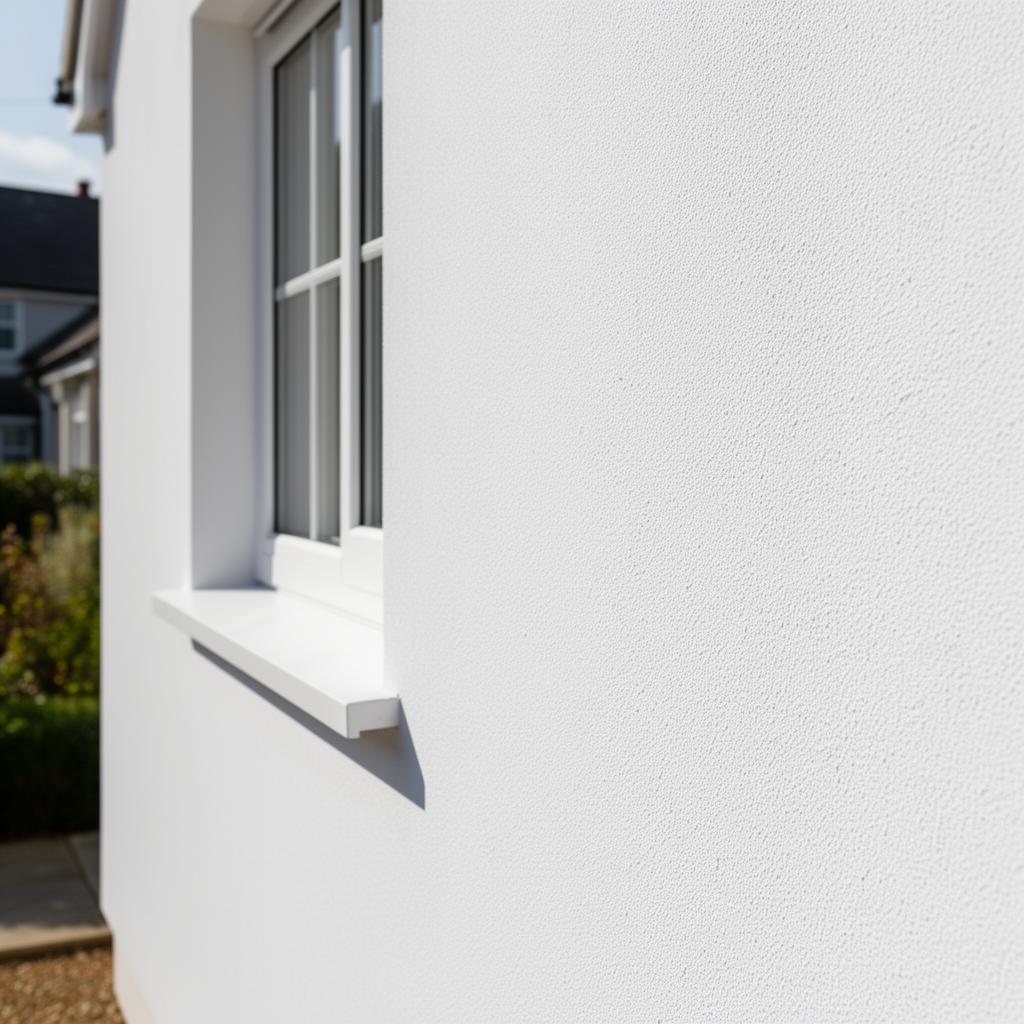
Coad's Green property owners usually call about colour rather than dirt. Growth flattens the tone of a painted render and stone finish long before anyone would call the wall unclean.
Quote for a Coad's Green property
Monday to Saturday, 8am – 7pm
Why walls green up in Coad's Green
- A drying rack or store built against a wall keeps that panel of it permanently shaded.
- Algae needs moisture far more than it needs dirt, so the wettest elevation greens first regardless of how clean the house is.
- A downpipe discharging onto a hard surface next to the wall sends the water straight back at the brickwork.
- Where a downpipe discharges into a gully that has silted, the overflow soaks the wall base each winter.
- Where a gutter joint weeps rather than pours, the stain is thin, vertical and very persistent.
- Lichen prefers hard, alkaline surfaces, which is why it shows on mortar and cills before it shows on render.
- Cold bridging at a lintel can keep a narrow band of render damper than everything around it.
- Driven rain sticks to a wall face rather than running off it, which keeps the surface wet long enough for spores to settle.
- A wall shaded by its own porch roof for half the day dries at half the rate of the face beside it.
What the staining pattern tells us
- 01The condition of the cills tells you how much water has been running down the face.
- 02Old repair patches are identified early, because they take treatment differently from the surrounding finish.
- 03Previous cleaning is usually visible as a slightly different texture rather than a different colour.
- 04Hollow-sounding render is checked by tapping before any water is put onto it.
- 05Weep holes are counted and checked for blockage while the wall is being read.
- 06The angle of morning sun on the elevation tells you how long it stays damp.
- 07Where a wall meets a roof abutment, the flashing is looked at first.
- 08A wall that feels chalky under the hand is telling you the coating has aged, not that it is dirty.
Getting a Coad's Green property ready
- Tell us about any planting you particularly care about at the base of the wall.
- Tell us if a gutter has been overflowing, because that changes what we look at first.
- Let us know if anyone in the house works nights and needs quiet at a particular time.
- Point out any alarm sensor mounted externally on the elevation.
- Tell us where the drains run if the garden has a soakaway rather than a mains connection.
- Close and latch every window on the elevations being worked, including any small top lights.
- Let us know whether the gutters have been cleared in the last couple of years.
- Point out where the render was patched, since patches clean differently from the original.
What the surface will and will not take
- Thin-coat systems are thinner than people assume, and a jet held still in one place leaves a permanent shadow.
- Cracks in render change the staining pattern, because water then sits behind the face as well as on it.
- Chalking paint is a rougher surface than new paint, which is why older painted walls green faster.
- Peeling in flakes means adhesion has gone; powdering under the hand means the surface has simply aged.
- Stone elevations vary enormously in hardness, and the pointing is usually the weakest part.
- A stone wall in deep shade holds moss in the joints long after the faces have dried.
The method we would use in Coad's Green
- 1.Vents, extractor terminals and trickle vents get taped, because water pushed into them is the one thing that turns an exterior job into an interior one.
- 2.The van is parked so hoses do not cross a footpath, and matting goes down where they have to.
- 3.Chimney stacks are treated from a position that keeps the operator off the roof covering entirely.
- 4.Fixings for hanging baskets and washing lines are unloaded before the elevation is worked, then put back.
- 5.Ridge and verge debris that has landed on the wall head is brushed off dry before anything wet goes on.
- 6.Growth in a shaded return is treated on the same visit even when only the front was asked about, if access allows.
- 7.A pass along the underside of the soffit catches the black spotting that everyone forgets until the wall is clean.
- 8.Treatment goes on from the bottom of the elevation upwards, which stops clean streaks forming where liquid runs onto dry surface.
- 9.Where two different finishes meet on one elevation, they are treated as two jobs on one wall.
- 10.The treatment is mixed to the surface, not to a fixed recipe, and a delicate finish gets a weaker mix and a longer wait.
Practical questions answered
- Do you clean chimney stacks?
- Where they can be reached safely from a position that keeps us off the roof covering.
- What about the neighbour's side?
- We only work surfaces you own or have permission for, and we check before spraying near a boundary.
- Do you work on flats and shared buildings?
- Yes, with permission from whoever is responsible for the elevation.
- Is there any risk to the guttering?
- No. It sits in the same spray path and gets wiped as part of the pass.
- Do you clean render above a flat roof?
- Yes, with the roof covering sheeted and the drip detail checked.
- Will treatment damage a wildlife pond?
- Ponds are sheeted and run-off is diverted well away from them.
- Is it safe around pets?
- Keep them indoors during application and for a couple of hours after, and there is nothing to worry about.
- Do you need a parking space?
- Somewhere within hose reach of the elevation is enough.
Why order matters more than speed
Rendering or repair work should always finish before cleaning starts, never the other way round.
Block paving cannot be re-sanded until it is dry, which decides the running order in a wet week.
Driveways come after walls so that run-off from the elevation is rinsed away as part of the drive work.
Conservatory roofs go before the wall above them, then get a final rinse afterwards.
Neighbouring places we work
PL15 context
- Nearest full coverage hub: Callington (PL17), Cornwall Council.
- Access is usually via A388 and A390.
- Callington sits about 6.4 miles from Coad's Green on our round, so visits are often shared.
- Postcode district: PL15. County: Cornwall. Approx 19.4 miles from the PL3 base.
- Typical wall finish here is painted render and stone, which sets the cleaning method.
Summary
Getting the order of work right protects the money already spent on the parts that were cleaned first. Low pressure is not a compromise. On render it is the only sensible option. Written scope first means nothing is discovered late. Monday to Saturday, 8am to 7pm.
Talk it through on the phone
Five minutes on the phone usually settles what a form cannot.