
Render and wall cleaning in Stokenham
cob and painted render walls, slate roofs, 18.2 miles from the yard.
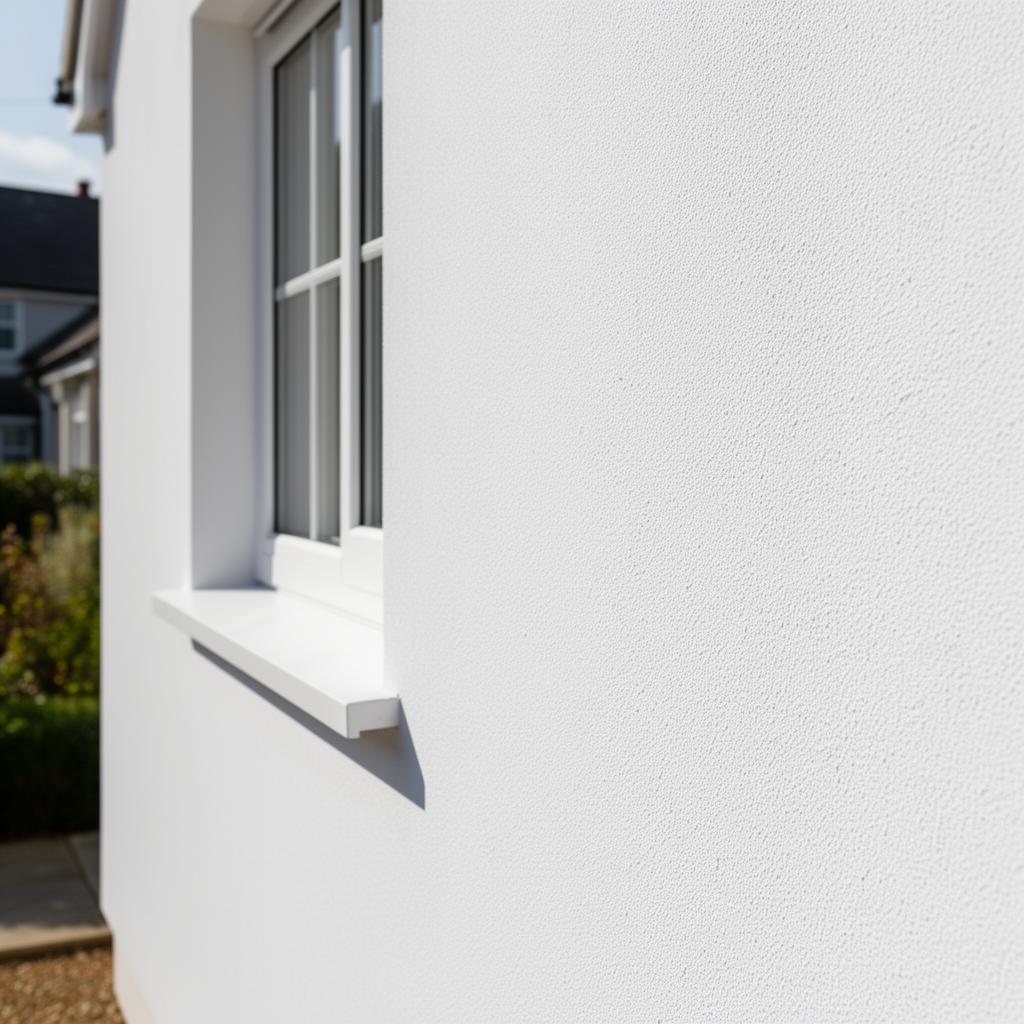
Most enquiries from Stokenham start with one elevation that has gone darker than the rest. Nine times out of ten the reason is how long that face stays damp, not how dirty it is.
Quote for a Stokenham property
Monday to Saturday, 8am – 7pm
Why walls green up in Stokenham
- Frost damage opens the surface slightly, which gives the next season's growth somewhere to sit.
- Old sealant around window heads cracks and lets a thin trickle run down the face below.
- Salt-laden air roughens exposed surfaces slightly, and rougher surfaces hold more moisture.
- Growth that appears in a neat rectangle usually marks something that was leaning against the wall.
- A blocked hopper head can soak the same square metre of wall for an entire winter without anyone noticing.
- Roof valleys concentrate run-off, so the wall under a valley outlet is loaded more heavily than anywhere else.
- A wall next to a busy road picks up a film of traffic grime that holds moisture on the surface.
- A wall under a mature hedge takes both shade and constant leaf litter, which is the worst pairing there is.
- A downpipe discharging onto a hard surface next to the wall sends the water straight back at the brickwork.
What the staining pattern tells us
- 01Any staining that continues below ground level is a drainage question, not a cleaning one.
- 02The age of the finish is estimated before a strength of mix is chosen.
- 03The direction the growth thickens in points at the source of the moisture.
- 04Weep holes are counted and checked for blockage while the wall is being read.
- 05Where the pattern is a band at the top, the gutter line is doing it.
- 06Where the pattern is vertical and narrow, plumbing is looked at before chemistry is.
- 07Nearby properties with the same finish are a useful reference for what is normal on that street.
- 08The mortar is tested with a key at a discreet point, since soft mortar sets the whole method.
Getting a Stokenham property ready
- Flag any recent repair or repaint, because fresh work is treated more gently.
- Let us know whether the gutters have been cleared in the last couple of years.
- Mention shared access or a right of way that we will be crossing.
- Mention any glazing you already know is cracked before work starts.
- Say if you would prefer the front done on a different day from the back.
- Tell us about any previous treatment that came back quickly, and how quickly.
- Say if the property has a flat roof section that we would be working above.
- Tell us if a gutter has been overflowing, because that changes what we look at first.
What the surface will and will not take
- Coloured through-render fades gradually, so what looks like dirt on an older wall is sometimes age in the finish.
- Patched render takes treatment differently from the original, which is why patches are identified before work starts.
- That gets pointed out before work starts rather than discovered halfway through.
- Cleaning before repainting is not optional, because paint over live growth fails from underneath.
- Where cob has been cement-rendered at some point, that render traps moisture and the wall behaves badly.
- Thatch or deep eaves above cob change how much of the wall ever gets wet.
The method we would use in Stokenham
- 1.A final walk of each finished elevation happens with the property owner where they are home, and by photograph where they are not.
- 2.The lower band of an elevation is checked for salt or silt staining, which is rinsed rather than treated.
- 3.Hoses run outside gates where children or dogs are about, and gates are closed behind us each time.
- 4.Where a wall carries a satellite dish or cable run, the fixings are checked before they get wet.
- 5.Dwell time is the active ingredient. The treatment is left on the growth long enough to kill it rather than being chased off with water.
- 6.Painted elevations get a small test patch first, low down and out of sight, so failing paint is found deliberately rather than by accident.
- 7.Vents serving a boiler or flue are checked and left uncovered, with the elevation around them worked dry.
- 8.Where a porch roof sits mid-elevation, it is sheeted and its own tiles cleared before the wall above is touched.
- 9.The elevation is walked first and anything loose, open or already failing is noted before a drop of water goes near it.
- 10.Chimney stacks are treated from a position that keeps the operator off the roof covering entirely.
Asked most often in TQ7
- Can lichen be removed completely?
- The organism is killed, and what is left weathers off. Deeply rooted lichen on stone can take a season to fade.
- What if the render is cracked?
- We will point it out and work around it. Cleaning does not fix cracks and can make them more obvious.
- Do you work on flats and shared buildings?
- Yes, with permission from whoever is responsible for the elevation.
- Is timber cladding treated the same way?
- No. Cladding takes a weaker mix, and pressure is avoided entirely because it raises the grain.
- What if the render is hollow in places?
- It is tapped and mapped first, and hollow sections are treated dry-side only rather than soaked.
- What about the neighbour's side?
- We only work surfaces you own or have permission for, and we check before spraying near a boundary.
- Will it strip my paint?
- Sound paint is unaffected. Paint that has already lost adhesion may lift, which is why a test patch goes on first.
- Does softwash actually kill the growth or just wash it off?
- It kills it. The treatment is left on long enough to work, which is why the surface keeps lightening for a week or two after the visit.
First, next, last
Fascia and soffit cleaning is folded into the wall visit rather than being priced as a separate trip.
Driveways come after walls so that run-off from the elevation is rinsed away as part of the drive work.
Roof work always precedes wall work, because everything released from the slope lands on the elevation below it.
Solar panels are cleaned separately from the roof slope they sit on, and after it.
Close to Stokenham
TQ7 context
- Typical wall finish here is cob and painted render, which sets the cleaning method.
- TQ7 covers 7 town hubs and 29 villages or districts in our radius.
- Access is usually via A379 and A381.
- Nearest full coverage hub: Kingsbridge (TQ7), South Hams District Council.
- Postcode district: TQ7. County: Devon. Approx 18.2 miles from the PL3 base.
Stokenham wall softwash, in short
Wall growth is a moisture problem wearing a dirt costume. Treat the growth, sort the water, and the interval stretches out. Every coated wall has a maximum pressure it tolerates, and it is much lower than most people assume. The finish underneath is usually intact. It is the film on top that has aged. Monday to Saturday, 8am to 7pm.
Tell us what you have tried
If a previous clean did not last, that tells us something useful before we quote.