
Cleaning tired walls in Combe
painted render and stone walls, slate roofs, 8.3 miles from the yard.
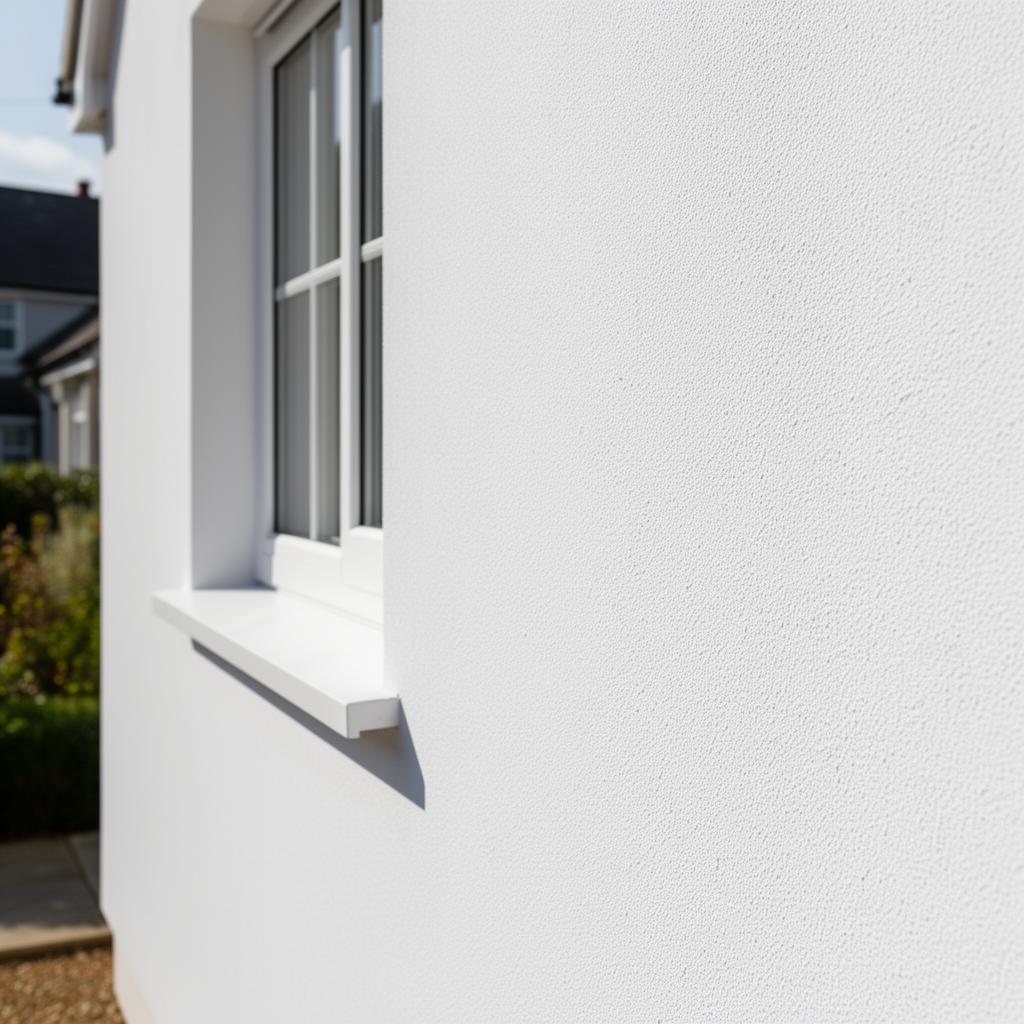
Combe is a estuary hamlet within the PL8 area, roughly 8.3 miles out from PL3 and one of 13 places we cover in that district. Its painted render and stone walls behave in a predictable way once you know the exposure.
Quote for a Combe property
Monday to Saturday, 8am – 7pm
Why walls green up in Combe
- Roof valleys concentrate run-off, so the wall under a valley outlet is loaded more heavily than anywhere else.
- Driven rain sticks to a wall face rather than running off it, which keeps the surface wet long enough for spores to settle.
- Sheltered gable ends collect airborne spores because there is no wind to move them along.
- Cold bridging at a lintel can keep a narrow band of render damper than everything around it.
- Where a wall sits below a bank or a raised garden, water arrives at it sideways rather than from above.
- Salt spray does not itself grow, but it roughens and holds damp, which is the same outcome.
- An untreated wall carries a spore load already, so regrowth after a rinse is faster than first growth ever was.
- Washing without a biocide simply resets the clock and leaves the roots in place.
- A textured coating applied over an already dirty surface holds that dirt as a feeding layer.
What the staining pattern tells us
- 01The angle of morning sun on the elevation tells you how long it stays damp.
- 02Anything that cannot be explained by water is treated with more caution, not less.
- 03The underside of the soffit is checked, because staining there rarely stays there.
- 04A slow walk of the gutter line from the ground finds most of the causes worth fixing.
- 05Hollow-sounding render is checked by tapping before any water is put onto it.
- 06A short section of hose test shows whether run-off drains away or ponds at the base.
- 07The elevation is read from the pavement first and from a metre away second.
- 08The mortar is tested with a key at a discreet point, since soft mortar sets the whole method.
Getting a Combe property ready
- Let us know if the property is listed or in a conservation area, as it affects method choice.
- If you have a pond, a water butt or a wildlife area, point it out in advance.
- Mention shared access or a right of way that we will be crossing.
- Note where the electricity meter and consumer unit sit relative to the wall.
- Flag any recent repair or repaint, because fresh work is treated more gently.
- Tell us if there is a low wall or a step at the base of the elevation that gets slippery.
- Say if you would prefer the front done on a different day from the back.
- Point out any window that does not seal properly, so it gets sheeted rather than sprayed near.
What the surface will and will not take
- Render cleans up well at low pressure and badly at high pressure, because pressure removes the finish along with the growth.
- Cracks in render change the staining pattern, because water then sits behind the face as well as on it.
- Chalking paint is a rougher surface than new paint, which is why older painted walls green faster.
- Peeling in flakes means adhesion has gone; powdering under the hand means the surface has simply aged.
- Rubble stone walls have deep joints that hold moisture and feed growth from within the joint.
- Copings on stone boundary walls take the worst of the weather and the worst of the growth.
The method we would use in Combe
- 1.The van is parked so hoses do not cross a footpath, and matting goes down where they have to.
- 2.Where a property is rendered onto insulation, extra care goes into avoiding water at the bead edges.
- 3.External light fittings are switched off at the consumer unit before the elevation around them is treated.
- 4.Ridge and verge debris that has landed on the wall head is brushed off dry before anything wet goes on.
- 5.The job is worked one elevation at a time from end to end so that nothing dries out mid-wall.
- 6.Dwell time is the active ingredient. The treatment is left on the growth long enough to kill it rather than being chased off with water.
- 7.The elevation is walked first and anything loose, open or already failing is noted before a drop of water goes near it.
- 8.Corners are worked from both directions so the overlap sits in the angle and not on the open face.
- 9.Treatments are kept away from vegetable beds entirely, with those sections sheeted rather than diluted.
- 10.Vents serving a boiler or flue are checked and left uncovered, with the elevation around them worked dry.
Straight answers before you book
- Do you treat mortar joints separately?
- The method is set by the mortar because it is nearly always the softest thing on the wall.
- Will treatment damage a wildlife pond?
- Ponds are sheeted and run-off is diverted well away from them.
- Can the whole house be done in one go?
- Often, depending on size and access. Larger properties split naturally into two visits.
- How much water does a wall job use?
- Less than a pressure wash, because the work is dwell time rather than volume.
- Does anyone need to be home?
- No. It is outside work. Access to the elevations, ideally an outside tap, and windows shut for the visit.
- Do you take the waste away?
- There is very little on a wall job. What comes off the surface is rinsed to a drain that can take it.
- Do you need my electricity?
- No. Kit runs off the van.
- Do you have a minimum size of job?
- A single gable or a porch is still worth doing properly.
What to book before and after the walls
Gutters are cleared between the roof and the walls, so the first heavy rain does not restain a finished elevation.
Where a roof clean is planned for later in the year, walls are worth leaving until after it.
If windows were cleaned recently, tell us, and they get sheeted rather than redone.
Roof work always precedes wall work, because everything released from the slope lands on the elevation below it.
Other Devon places on the same round
PL8 context
- Typical wall finish here is painted render and stone, which sets the cleaning method.
- Postcode district: PL8. County: Devon. Approx 8.3 miles from the PL3 base.
- Newton Ferrers sits about 0.6 miles from Combe on our round, so visits are often shared.
- Typical roof covering here is slate, which affects what washes down onto the walls.
- PL8 covers 5 town hubs and 8 villages or districts in our radius.
The essentials
The wall is nearly always sound. What has changed is what is living on it. A maintenance pass is far lighter work than a first clean, and it stays that way. Softwash trades speed for safety on the finish, and that trade is worth making on any coated wall. Monday to Saturday, 8am to 7pm.
Tell us what you have tried
If a previous clean did not last, that tells us something useful before we quote.