
Render and wall cleaning in Hessenford Village
painted render and stone walls, slate roofs, 11.7 miles from the yard.
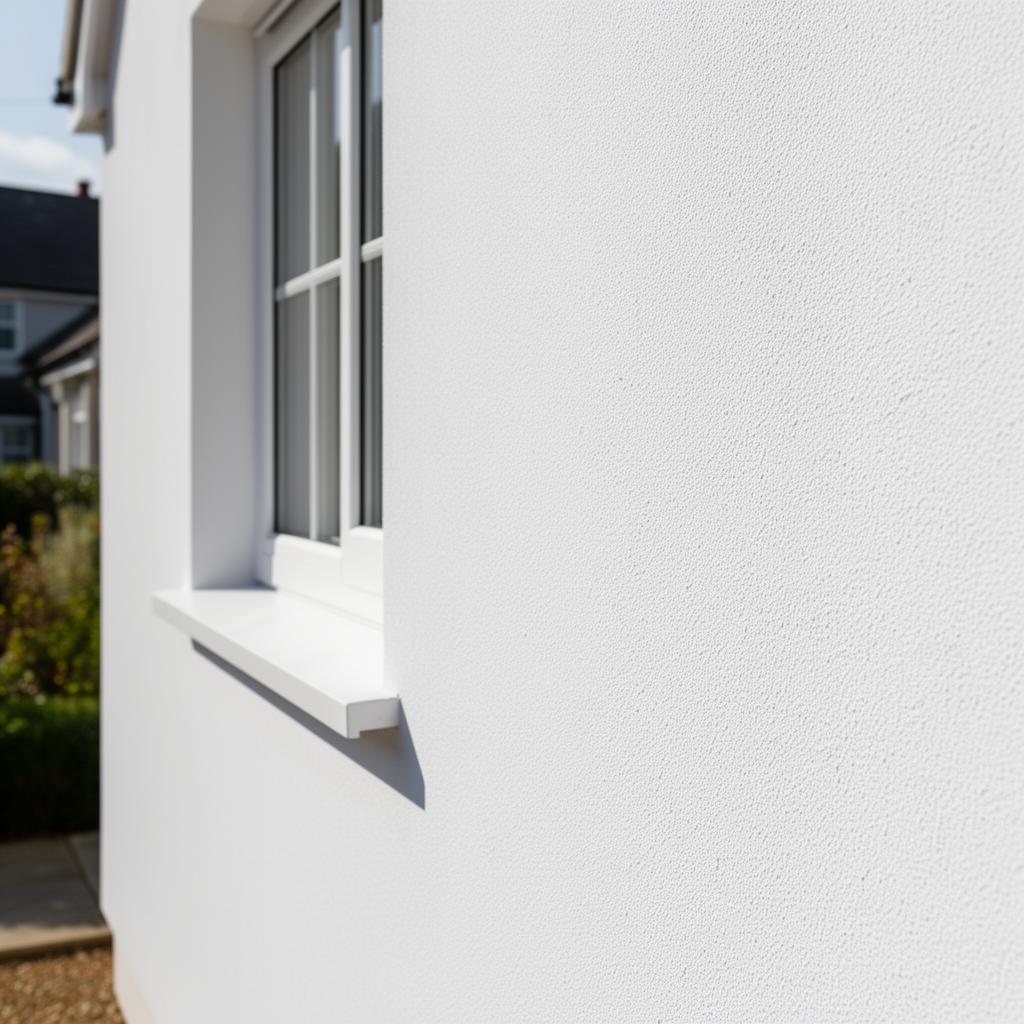
Hessenford Village is a village within the PL11 area, roughly 11.7 miles out from PL3 and one of 16 places we cover in that district. Its painted render and stone walls behave in a predictable way once you know the exposure.
Quote for a Hessenford Village property
Monday to Saturday, 8am – 7pm
Why walls green up in Hessenford Village
- Pebbledash holds water in the shadow of every stone, so it stays damp long after a flat render has dried.
- Salt-laden air roughens exposed surfaces slightly, and rougher surfaces hold more moisture.
- Sheltered gable ends collect airborne spores because there is no wind to move them along.
- Where two elevations meet in a tight internal corner, neither one dries properly.
- Wall growth often maps exactly to where a previous extension roof used to sit.
- Cold bridging at a lintel can keep a narrow band of render damper than everything around it.
- Old sealant around window heads cracks and lets a thin trickle run down the face below.
- Frost damage opens the surface slightly, which gives the next season's growth somewhere to sit.
- Hedging planted tight to a wall cuts airflow, and still air is the same as slow drying.
What the staining pattern tells us
- 01The condition of the cills tells you how much water has been running down the face.
- 02Efflorescence is distinguished from lichen before anything is applied, since one is salt and one is alive.
- 03Where the pattern is vertical and narrow, plumbing is looked at before chemistry is.
- 04A damp meter reading inside a stained corner separates a cleaning job from a building problem.
- 05Cracks are traced to their ends, because a crack that runs to an opening behaves differently from one that stops.
- 06The underside of the soffit is checked, because staining there rarely stays there.
- 07Where the pattern is a band at the bottom, splash from the ground is doing it.
- 08A short section of hose test shows whether run-off drains away or ponds at the base.
Getting a Hessenford Village property ready
- Say if any part of the wall has been jet washed before, and roughly when.
- Note where hoses can be run without crossing a doorway.
- Say where the outside tap is, and whether it runs at any pressure.
- Tell us where the drains run if the garden has a soakaway rather than a mains connection.
- Say whether the elevation backs onto a public footpath.
- Mention whether the drive drains to a soakaway that already struggles in heavy rain.
- Trim back anything that has grown tight against the wall, or ask us to work around it.
- Say if there is a wasp or bird nest under the eaves, and we will plan around it.
What the surface will and will not take
- Cracks in render change the staining pattern, because water then sits behind the face as well as on it.
- Coloured through-render fades gradually, so what looks like dirt on an older wall is sometimes age in the finish.
- Chalking paint is a rougher surface than new paint, which is why older painted walls green faster.
- Painted plinths take splash and are worked as a separate band from the main face.
- Copings on stone boundary walls take the worst of the weather and the worst of the growth.
- Treatment on stone is applied in stages so it soaks into the joints rather than running off the faces.
The method we would use in Hessenford Village
- 1.On render below a flat roof edge, the drip detail is checked, because a failed one puts the stain straight back.
- 2.On thin-coat systems the lance is kept moving, because holding it still in one place is how a shadow mark gets left behind.
- 3.Reach is taken from the ground with a telescopic lance wherever the elevation allows, which keeps ladders off soft render.
- 4.Fixings for hanging baskets and washing lines are unloaded before the elevation is worked, then put back.
- 5.Old paint flakes are removed by hand before treatment rather than blown around by water.
- 6.A final walk of each finished elevation happens with the property owner where they are home, and by photograph where they are not.
- 7.Work stops if a wall turns out to be wetter inside than out, because cleaning is not the answer to that.
- 8.Anything that has to be moved - bins, planters, a bike - goes back exactly where it was found.
- 9.Access equipment is footed on boards where the ground is soft, so nothing sinks into a lawn.
- 10.Cable clips, aerial brackets and old fixings are noted, and loose ones are left rather than pushed further.
Asked most often in PL11
- What happens to the growth after it dies?
- It loses its grip and weathers off over the following weeks, which is why the wall keeps improving.
- Do you jet wash walls?
- Not on render, pebbledash or paint. Pressure takes the finish off with the growth and brings the problem back sooner.
- Can you clean a wall before painting?
- Yes, and it should be done first. Paint over live growth fails from underneath.
- Will the colour come back?
- If the original finish is sound, the colour underneath is usually still there and comes back with the growth removed.
- Is there any risk to the guttering?
- No. It sits in the same spray path and gets wiped as part of the pass.
- What if the render is cracked?
- We will point it out and work around it. Cleaning does not fix cracks and can make them more obvious.
- Will treatment damage a wildlife pond?
- Ponds are sheeted and run-off is diverted well away from them.
- How do you price the work?
- By elevation area and access, put in writing before anything starts.
First, next, last
Gutters are cleared between the roof and the walls, so the first heavy rain does not restain a finished elevation.
Glass is done last on any multi-service visit, since it picks up whatever the earlier stages put in the air.
Driveways come after walls so that run-off from the elevation is rinsed away as part of the drive work.
Rendering or repair work should always finish before cleaning starts, never the other way round.
Close to Hessenford Village
PL11 context
- Nearest full coverage hub: Hessenford (PL11), Cornwall Council.
- Hessenford sits about 0 miles from Hessenford Village on our round, so visits are often shared.
- Postcode district: PL11. County: Cornwall. Approx 11.7 miles from the PL3 base.
- Recorded character: village. A387 river-bridge village between Torpoint and Looe.
- PL11 covers 4 town hubs and 12 villages or districts in our radius.
Useful pages alongside this one
Hessenford Village wall softwash, in short
Every visit ends with the elevation judged from where people actually see it. Shade, run-off and airflow decide how long a clean lasts. The treatment decides whether it worked at all. Written price first, method matched to the surface, then the work. In that order.
Book before the wet months
A wall treated now goes into winter clean, which is when the difference is most visible.